Showing posts with label Avant-Garde. Show all posts

Wednesday, September 24, 2008

Blues for a Black Cat


Boris Vian (1920-59) led a rather too short life on this earth. But, within that 39 years, he wrote 10 novels, 42 short stories, 7 theatre pieces, 400 songs, 4 poetry collections, 6 opera libretti, 20 short story and novel translations. He was praised by stalwarts like Jean Paul Sartre, Louis Malle and Eugene Ionesco. His novels range from metaphysical fantasies to hardcore potboilers. Blues for a Black Cat is probably his only short story collection translated into English.

This anthology, consisting of 10 brilliant short stories, provides a perfect introduction to the world of Vian—a world full of feverish imagination and uncouth happenings. To give an idea, let me cite one or two examples—in these short stories, you’ll find a musician who earns his living by selling his sweat, a cat which has a distinct British accent, and a group of people travelling in train who brutally torture a fellow-traveller for not being talkative enough. In short, it is an explosion of unrestrained imagination which leaves the reader gasping for breath.

But, are these short stories nothing but fantasies, mere spurt of fretful daydreaming, full of clever wordplays and creative juggleries? Sorry, I beg to differ. Through these brilliant fireworks of Vian’s imagination one cannot fail to notice a gloomy world, full of pain and suffering. Vian repeatedly highlights the absurdity of our existence—an existence blighted by oppression, terror and helplessness. That’s why, Vian’s characters are so much plagued by unruly gadgets, brutal superiors or heartless fellow creatures. Also, Vian’s radically transgressive logic hints at the basic irrationality of the world surrounding us. His attitude is quite similar to that of Beckett or Ionesco, but more playful and a lot more mischievous. His scathing black humour reveals the raging mind behind all the apparent fun and fanfare.

Here, I want to specially mention the story “Pins and Needles”, a vitriolic analysis of a war-ridden era. Though one can safely assume that the story describes the landing of allied force in France, the incidents actually take place in an ambiguous time and space. As a reviewer aptly puts it—
“The unstable, shifting nature of Vian's prose—alternating here between deadpan serious and craftily naive—perfectly captures the confusion of the battlefield, rendering the horrendously violent subject matter as black humour of a deeply chilling variety. More than a parody of battlefield horrors, unnerving enough as that may be, the story turns one of the most hallowed battles of recent history into an absurdist melange of death, dismemberment and pain, signifying nothing. An excerpt: "We got behind the tank. I went last because I don't have much confidence in the brakes of those contraptions.... But I don't like the tank's manner of reducing corpses to a pulp with the sort of noise that's hard to remember--at the time you hear it, though, it's pretty unmistakable."”
“Pins and Needles” is probably the best anti-war story I’ve come across, painstakingly revealing the absurdity of war and its meaninglessnes.

Due to his abhorrence to the Cartesian logic of “Cogito Ergo Sum”, Vian became interested in Pataphysics and, as a reviewer rightfully says, “Blues for a Black Cat” betrays “Vian's Pataphysical sensibility and love of language play”. Above all, Vian’s stories are much too funny to be carelessly laughed at.

Lastly, I want to thank Rupa & Co. for introducing Vian to Indian readers. “Rupa France” is doing a great job, offering us some of the most prestigious literary experimentation, ranging from Andre Malraux to Daniel Pennac, from Louis Ferdinand-Celine to Didier Daeninckx.

Saturday, September 20, 2008

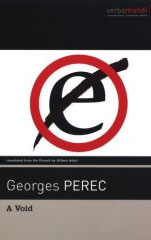
Looking into A Void

A Void (in French, La Disparition), written by Georges Perec in 1969 without using the vowel “e” , is probably the finest example of lipogrammatic fiction in world literature (you’ll find a short Wiki tutorial on Lipogram HERE).

The book is a kind of metaphysical thriller, following the well-acclaimed Borgesian tradition. The protagonist of the book, Anton Vowl, suddenly disappears from his residence in Paris. His friends try to solve the mystery of this strange disappearance by rummaging through Vowl’s diary, notes and letters, containing mostly his strange word plays, metaphoric writings and yes, lipograms. In the process of getting into the heart of the mystery they find themselves at the very centre of an atrocious and hyperbolic conspiracy which puts their own lives in danger. The book goes on unfurling plots after plots which become more and more complicated each time, involving murders, family secrets and relentless pursuit after trails. The book is also infested with Perec's notorious cross-references and red herrings. Here, amongst other things, we find a lipogrammatic version of Rimbaud's poem and that of Shelley's Ozymandias.

The pun in the title quite succinctly describes its theme—it is a book about a void as well as avoidance. The book has a void due to its strange avoidance of the vowel “e”, which, in turn, determines the fate of its characters (remember the surname of the protagonist—Vowl, a vowel without an“e”). That’s why, throughout the book we repeatedly come across a strange folio consisting of 26 volumes, out of which the 5th one is always missing. In fact, the book itself has 26 chapters but there is no 5th chapter in it, but a conspicuous blank page instead. Each of the characters in the book is a prey of an unavoidable destiny. The shadow of a past mystery runs after their lives and curiously links them up to a common misfortune. It hints at the fact that we all have a void inherent in our existence and however hard we try to avoid that, it doggedly chases after us and determines our fates. On the other hand, if we somehow manage to peep into that void, we are doomed forever. Characters in this book are in search of that void because finding it out will give a meaning to their otherwise absurd lives—that is, being mere puppets within their own socio-political milieu, without the ability to intervene or change its course. They pursue it through joining the missing links, following the faint trail of some distant possibilities and by pure coincidences, thereby trying to overcome their limitations and restrictions (it also brings forth the limitation of the book itself, the restriction of not using “e”). But at the end, all their efforts amount to a fatalistic blow, exterminating themselves. So, eventually, the book becomes a commentary on its own self, desperately trying to give a meaning to a random sequence of events, and once that is done, it has to stop, to come to an inevitable conclusion.

PS: When I first started reading the book, I was quite put off as the language appeared to me a bit phony and cumbersome. I was actually blaming Perec mentally for writing such a book after the brilliant feat of “Life: A User’s Manual. For the initial 14 chapters, I just carried on reading as I didn’t want to add another book to my “to be read” collection and was trying to finish it as soon as possible. But my interest started building up from section IV of the book (it has six sections in total, without any section II), and after that, it was a complete literary whirlwind which didn’t allow me to put down the book once, except for that 40 winks at night (that too, chock-full of nightmares).

Sunday, September 14, 2008

Life: A User's Manual by Georges Perec : A Diabolic Creation

Seldom you come across a book which is so magnificent in its scope, so disarmingly rich in style and variation, that after finishing it, you feel quite numb and dull. And later, when you try to reflect on the book, you are desperately short of words and expressions. Common examples include James Joyce’s “Ulysses” or Dostoyevsky’s “Brothers Karamazov”.

Recently, I’ve finished reading Life: A User’s Manual by Georges Perec and without hesitation, I’ve placed it in the aforementioned category.

I’m supposed to call “Life: A User’s Manual” a book, or a novel, but I prefer the word ‘tapestry’, and indeed, it is an ingenuous one. The title page describes it as “Novels”, in plural, and we’ll understand its significance a little later. The central character of the narrative is a wealthy Englishman called Bartlebooth (recently I've come to know that this is a cross between Herman Melville’s Bartleby and Valery Larbaud’s Barnabooth; such tongue-in-cheek references are abundant in this piece of work) living in a Parisian apartment at 11, Rue Simon-Crubellier. Not knowing what to do with his time or his fortune, he contrives an extensive plan which will keep him busy for the rest of his life. His plan goes as follows—

  • In the first 10 years he devotes himself learning the techniques of water-colour under the guidance of Valene, who also comes to live at 11 Rue Simon-Crubellier.
  • Then, he starts his voyage spanning a period of 20 years around the world, accompanied by his faithful butler Smautf (an obvious reference to Jules Verne’s “Around the World in Eighty Days”, bringing back the sweet memories of my childhood days) and painting 500 landscapes in different ports in different countries.
  • As soon as he finishes each of these canvases, it is sent to Gaspard Winckler, a clever and ingenuous craftsman (another resident of 11 Rue Simon-Crubellier) who converts it into a jigsaw puzzle, increasingly difficult in nature, and stores them for future.
  • After returning from his voyage, Bartlebooth solves those jigsaw puzzles.
  • Each of the solved puzzles is then transferred to Georges Morellet (still another resident of the same building) who then rebinds the paper with a special glue and restores the original painting, removing the support of the pasteboard.
  • This painting, which is in almost the identical state when Bartlebooth painted it, is then sent to the port where it was painted, exactly 20 years after the day of its creation.
  • The painting is then placed into seawater until the colour dissolves, leaving a plain virgin sheet of paper.
  • This blank sheet is then returned to Bartlebooth.
  • The whole process is repeated for all the 500 paintings.

Now, as the narrative progresses, it dawns upon the readers that the novel is set not only on the day of Bartlebooth’s death, but also, at the precise moment of his death. All the characters and objects, living in the microcosm of this Parisian apartment, are frozen in time and space by the author as he goes on painstakingly describing each of them, in each of the flats in the building, where they are and what they have been doing at that fateful moment, with elaborate references to their past, present and future. And this act of describing them is actually what the novel consists of. Probably now, the word “novels” makes some sense, because in the course of this narrative, we’ve come across more than 100 main stories (concerning all the residents and their lives), spanning almost 142 years (1833-1975).

But, what is the point of telling such a convoluted array of stories? And, moreover, what is the point of indulging oneself into such a tedious and futile endeavour like Bartlebooth? The answers are the same—NOTHING!

The most striking characteristic of this tapestry is its capability of referring to itself and its elements. The book itself is in the fashion of a vast jigsaw puzzle, similar to the ones Bartlebooth has been solving throughout his life. All the different stories and characters are the random pieces of the puzzle. As you are going through them, you engage yourself in joining them together, groping around in dark, unsure of yourself. Eventually, at the end, this tapestry emerges with full splendour.

The quixotic effort of Bartlebooth and that of the author touch upon yet another theme. However hard a person tries to attribute a meaning to an act, ultimately it is devoid of any significance, or rather, if it has any significance at all, that is purely random (remember Sassure’s “Signifier - Signified” duo which is random). We are nothing but preys of an illusory meaningfulness which we pursue till the end of our lives. The effort of both Bartlebooth and Perec is a mockery of this illusion. At the end, Bartlebooth dies without finishing the project, in the process of becoming aware of the impossibility of such a task.

While Bartlebooth’s bizarre project provides the central theme, 11 Rue Simon-Crubellier gives the book its structure. Supposedly, the narrative moves like a Knight in a chess game, one chapter for each room (thus, the more rooms an apartment has the more chapters are devoted to them). Perec haults in each room and tells us about the residents of the room, or the past residents of the room, or about some of their acquaintances. Perec devises the elevation of the building as a 10×10 grid: 10 storeys, including basements and attics and 10 rooms across, including 2 for the stairwell (the plan is given at the end of the book, along with a 58 pages long Index!). Each room is assigned to a chapter, and the order of the chapters is given by the knight's moves on the grid.

George Perec was a member of the OuLiPo ("Ouvroir de littérature potentielle", which translates roughly as "workshop of potential literature") group. The members of the group were devoted to “constrained writing” techniques (Perec himself wrote an entire book without using the vowel e for once). In this novel also, there are certain constraints that he subjects himself to, like the number of lists in each chapter, number of objects etc. Unfortunately, as an uninitiated reader, I couldn’t delve deep into such numerological nitty-gritty.

The book swarms with numerous references to other authors, books and characters, including Jules Verne, Captain Nemo, Passepartout, Kafka, Nabokov, Gaston Leroux, Cheri-Bibi, Marcel Proust and so on. As a novice reader it is an unpardonable audacity to even think of uncovering all those subtle nuances, but if you can, at least, sneak a peek at some of them, you will be justly rewarded. But be careful, there are plenty of red herrings, which may soon thwart you off the track.

Another nasty twist at the end of this post! It is not Perec, who is describing all these disparate elements of a story. Rather, he is just describing the concept behind an unfinished sketch by Valene (the art teacher of our old friend Bartlebooth), aspiring to depict the building and its residents in fullest possible details (yes, along with the incidents from their past lives). Valene stops working on this painting precisely at the moment of Bartlebooth’s death!

What should be said about this one-of-its-kind book, if not diabolic?

PS: You'll find an extensive review of "Life: A User's Manual" HERE, A short bigraphical note on Perec HERE, and Reviews of other books by Perec HERE